1. Independent reading reading- First 10 minutes.
2. Take out notes on Machiavelli's The Prince.
3. In Schoology, respond to the prompt on your reading.
4. When you are done, you will need to read through the handout of Machiavelli quotes from The Prince.
The Prince Quotations- List
5. Read through the following assignment. Visual image and response is due at the beginning of class on Friday, January 18th.
The Prince and Power Assignment Sheet
Monday, January 14, 2019

Friday, January 11, 2019
January 11th
1. Independent reading- First 10 minutes.
2. Turn in your power quote analysis response.
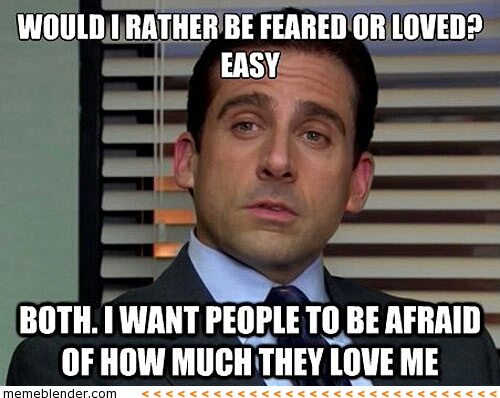
3. Machiavelli's The Prince- Excerpt
- Read: The Dedication, Chapter 1, Chapter XVII, and Chapter XVIII
- Take notes as you read. Track what is happening, advice by author, purpose of the text, relationship to what we have been discussing in the last week.
Things to consider when reading:

2. Turn in your power quote analysis response.
3. Machiavelli's The Prince- Excerpt
- Read: The Dedication, Chapter 1, Chapter XVII, and Chapter XVIII
- Take notes as you read. Track what is happening, advice by author, purpose of the text, relationship to what we have been discussing in the last week.
Things to consider when reading:
- Weber's definition of power. How does Machiavelli's writing interact with this definition?
- What do you think Machiavelli's purpose in writing The Prince?
- What do you think the TONE is? Serious? Warning? Instructional? What examples do you have to support these findings?
- What are the qualities of the ideal prince, according to Machiavelli? Are they clearly stated or hidden in subtext?
- What specific lines stand out to you as significant?
Thursday, January 10, 2019
January 9th and 10th
We will meet in the LMC today.
You will have the opportunity to check out another independent reading book, and have time to read.
Remember, your typed revised draft over your power quote. You will staple this to your first color-coded draft. This is due when you walk into class on Friday, January 11th.
You will have the opportunity to check out another independent reading book, and have time to read.
Remember, your typed revised draft over your power quote. You will staple this to your first color-coded draft. This is due when you walk into class on Friday, January 11th.
Tuesday, January 8, 2019
Tuesday, January 8th
1. Independent reading- First 10 minutes.
2. Review and Revision of the first draft of your literary analysis on power.
Color coding your draft for CONTENT:
BLUE: Where you are addressing the WHAT?
What is your conclusion? What occurs? What do you see?
GREEN: Where you are addressing the HOW?
How do the conclusions occur? How is this specifically seen? How does this illustrate your argument? How does this point connect to another text? How does a literary device achieve the purpose of the text/meaning? How does meaning occur?
RED: Where you are addressing the WHY?
Why do you think this is important? Why do you think the author is doing this? Why does this occur in this text?
We are currently looking at how you address the text. With every WHAT . . . you need to pair it with a minimum of one HOW . . . and an accompanying WHY. You may have to make some adjustments or move things around. You most likely will have to add, but possibly subtract.
1. Do you have a topic sentence to start your analysis? Think about what you are introducing in the writing you have just done.
2. Are you pleased with the order of your evidence? Does it appear in an order that is thoughtful? Rational?
3. Are you using transitions between your ideas and the different purposes that are addressed above?
4. Do you have a conclusion statement wrapping up what your argument is... or the significance of it?
5. Have you double checked your SPELLING? SENTENCE STRUCTURE? CAPITALIZATION? PUNCTUATION?
6. Do you have the MLA heading? Header (name and page number?) Title?
3. Your revised draft needs to be printed off and stapled on top of the color coded draft. This is due FRIDAY, January 11th at the beginning of class. This needs to be printed off BEFORE CLASS. You will not be excused to go print.
2. Review and Revision of the first draft of your literary analysis on power.
Color coding your draft for CONTENT:
BLUE: Where you are addressing the WHAT?
What is your conclusion? What occurs? What do you see?
GREEN: Where you are addressing the HOW?
How do the conclusions occur? How is this specifically seen? How does this illustrate your argument? How does this point connect to another text? How does a literary device achieve the purpose of the text/meaning? How does meaning occur?
RED: Where you are addressing the WHY?
Why do you think this is important? Why do you think the author is doing this? Why does this occur in this text?
We are currently looking at how you address the text. With every WHAT . . . you need to pair it with a minimum of one HOW . . . and an accompanying WHY. You may have to make some adjustments or move things around. You most likely will have to add, but possibly subtract.
- Once you have addressed the content of the writing... making sure that you have a matched up "what, how, and why," you are going to look to writing structure.
1. Do you have a topic sentence to start your analysis? Think about what you are introducing in the writing you have just done.
2. Are you pleased with the order of your evidence? Does it appear in an order that is thoughtful? Rational?
3. Are you using transitions between your ideas and the different purposes that are addressed above?
4. Do you have a conclusion statement wrapping up what your argument is... or the significance of it?
5. Have you double checked your SPELLING? SENTENCE STRUCTURE? CAPITALIZATION? PUNCTUATION?
6. Do you have the MLA heading? Header (name and page number?) Title?
3. Your revised draft needs to be printed off and stapled on top of the color coded draft. This is due FRIDAY, January 11th at the beginning of class. This needs to be printed off BEFORE CLASS. You will not be excused to go print.
Monday, January 7, 2019
Monday, January 7th
1. Independent reading- First 10 minutes
2. For class today you selected 5 quotes from the 37 to examine in the context of our larger discussion about power. In addition to your notes you should already, discuss in your small group the following ideas:
EXAMPLE:
Do the thing and you will have the power. - Ralph Waldo Emerson
In his quote, "Do the thing and you will have the power," Emerson proposes that power is subjective. This idea coincides with Weber's definition of power. Weber's approach to explaining power is centered upon the individual's ability to go achieve their own goals, surpassing obstacles. This is emphasized with the use of the article "the" before the word "power" in the quote. By including "the" before "power," it is presented as something concrete to obtain by doing "the" thing-- the article of "the" repeated being again. Both Emerson and Weber emphasize the action(s) of the doer, and what is done. Furthermore, in this quote, Emerson points to the doer by referencing the 2nd person pronoun "you." The individual on the receiving end of this sentiment is given the power by Emerson to determine what gives them power. This is highlighted by a purposefully ambiguous word choice of "thing." The reflection upon the diction choice of "thing" prompts one to recognize that they do indeed have power, or have access to achieving power by being able to choose their specific "thing." As result, power is philosophical and conceived by the individual. With further evaluation, however, brings up the question if Emerson is challenging us to de-emphasize the quest for power in our lives because of its constant accessibility. Because power is available to everyone by the "thing(s)" they are prompted to recognize, and "the" power that should be the goal, does power hold the "power" it is believed to hold?
Do you have everything you need? Check through . . .
2. For class today you selected 5 quotes from the 37 to examine in the context of our larger discussion about power. In addition to your notes you should already, discuss in your small group the following ideas:
- Put quote into your own words.
- What literary devices do you see being utilized?
- What advice does this quote seem to offer?
- Is the focus interior? Exterior?
- How does the literal meaning support or emphasize the figurative meaning?
- What specific words (diction) in the quote are supportive of your findings/understanding?
- Why do you think the speaker is making this statement?
- Any contradictions in the definition? Contradictions with Weber?
EXAMPLE:
Do the thing and you will have the power. - Ralph Waldo Emerson
Do you have everything you need? Check through . . .
- Are you referencing the speaker by last name in response?
- Are you citing specific words to support your findings?
- Are you using accurate capitalization and punctuation?
- Are you explaining the meaning of the quote?
- Have you referenced how it interacts with Weber's definition?
- Do you have MLA heading?
- Have you printed this off for class on Tuesday?
Friday, January 4, 2019
Friday, January 4th
1. Small group Socratic seminar over Ted Talk on POWER.
Socratic seminar reminders:
2. Read through each of the following quotes on power: 37 Quotes on Power
3. Select 5 quotes that you feel that truly embody what you understand about power: its definition; its application.
4. In your notes, write each of the 5 selected quotes. Under each quote, start working through the quotation.. Its meaning? Its relationship to Weber's definition? Its application?
Bring your quotes and notes to class on Monday, January 7th.
** Remember to bring your independent reading books on Monday, too!
Socratic seminar reminders:
- Connect everything back to the text of study.
- Explore the "hows" and the "whys".
- Paraphrase what is said before you.. and connect to this statement.
- Exhaust the question. Look for multiple possibilities.. perspectives.
Eric Liu implores that society becomes more literate in the nature of power. From his lecture, and your following seminar, how are you becoming more literate about your interaction with power? What do you think that you need to continue to learn? What revelations have you had?
Writing expectations: Thorough answering of the questions proposed. This means that you have addressed the prompt, provided examples, explained your examples, utilize transitions, etc.
Due by Sunday, January 6th at 11:59 PM. Late submissions will not receive a grade.
2. Read through each of the following quotes on power: 37 Quotes on Power
3. Select 5 quotes that you feel that truly embody what you understand about power: its definition; its application.
4. In your notes, write each of the 5 selected quotes. Under each quote, start working through the quotation.. Its meaning? Its relationship to Weber's definition? Its application?
Bring your quotes and notes to class on Monday, January 7th.
** Remember to bring your independent reading books on Monday, too!
Thursday, January 3, 2019
January 3rd- Happy New Year!
Power (as defined by Max Weber): “the ability of an individual or group to achieve their own goals or aims when others are trying to prevent them from realising them”
Weber identified power as being either authoritative or coercive. Authoritative power is exercising power which is seen as legitimate. By being legitimate it is effective because those who are subject to the power do so with consent.
In contrast coercion is where someone exercises power through force – you’re forcing someone to do something against their wishes.
1. When, how, and where do you feel power?
2. When, how, and where do you feel powerless?
Watch:
Why Ordinary People Need to Understand Power- Ted Talk
Take notes on the following:
From your notes, write 4 "how' and "why" type of questions. Make sure that your questions are examining the text we just viewed. Don't drift too much into the abstract "what if" scenario type of question.
I will be checking that your questions are done AT THE BEGINNING of class tomorrow.
Small Socratic seminar tomorrow. Review the guidelines and scoring guide for the seminar. Socratic Seminar Handout
Weber identified power as being either authoritative or coercive. Authoritative power is exercising power which is seen as legitimate. By being legitimate it is effective because those who are subject to the power do so with consent.
In contrast coercion is where someone exercises power through force – you’re forcing someone to do something against their wishes.
1. When, how, and where do you feel power?
2. When, how, and where do you feel powerless?
Watch:
Why Ordinary People Need to Understand Power- Ted Talk
Take notes on the following:
- What is the major argument that the speaker is making
- In what ways do you see Weber's definition of power apply in the argument and examples?
- What advice can you take away from this Ted Talk?
- What are some examples of power beyond your initial conceptions of exercises of power?
- What connections can you make to the discussion on power?
From your notes, write 4 "how' and "why" type of questions. Make sure that your questions are examining the text we just viewed. Don't drift too much into the abstract "what if" scenario type of question.
I will be checking that your questions are done AT THE BEGINNING of class tomorrow.
Small Socratic seminar tomorrow. Review the guidelines and scoring guide for the seminar. Socratic Seminar Handout
Subscribe to:
Posts (Atom)